
Theme: “Resilience Starts at Home”
Disaster resilience does not begin when a cyclone approaches, a flood washes away crops, or a community is forced to evacuate. It begins long before disaster strikes – in the knowledge people share, the relationships they build, the decisions they make, and the systems they strengthen together.
This is the central message of the 2026 International Day for Disaster Risk Reduction (IDDRR): Resilience Starts at Home.
For Timor-Leste, where communities face climate-related hazards, including droughts, floods, landslides and increasingly unpredictable weather patterns, this message carries particular significance. Disaster risk reduction (DRR) is not simply about responding to emergencies. It is about investing in people, strengthening local capacities and ensuring that individuals, families and communities have the knowledge, resources and support to anticipate, prepare for and recover from disasters.
At Oxfam in Timor-Leste, this understanding is reflected in our work with communities across Oe-Cusse, Liquiça, Ermera and Dili. Through collaboration with local partners, community leaders and government stakeholders, we support locally led approaches that connect disaster preparedness, climate resilience and inclusive development.
Our work is also a testament to the commitment of our teams and partners, whose collective efforts help translate resilience from a concept into meaningful action.
From Household Preparedness to Community Resilience
The home is often the first place where disaster impacts are experienced. It is where families protect their children, care for older relatives and people with disabilities, store food and water, and depend on their livelihoods. When disasters disrupt these foundations, the consequences extend far beyond physical damage. They affect income, education, food security and the ability of families to recover.
The 2026 IDDRR theme recognises that safer homes and resilient communities require more than individual preparedness. They depend on risk-informed planning, accessible information, resilient infrastructure and inclusive decision-making.
In Timor-Leste, this means ensuring that disaster preparedness is connected to the everyday realities of rural and urban households. A resilient home is not only one that can withstand a hazard; it is also one where people have access to water, food, safe livelihoods, early warnings and the resources needed to recover.
Working Together Across Oe-Cusse, Liquiça, Ermera and Dili
Oxfam in Timor-Leste’s disaster risk reduction work is implemented across Oe-Cusse, Liquiça, Ermera and Dili, working alongside local partners who bring strong community relationships, local knowledge and experience to the effort.
Through partnerships with MANEO, AFFOS, KSI, BIFANO, MDI and RHTO, Oxfam supports community-based approaches that strengthen preparedness, reduce disaster risks and promote inclusive resilience.
These partnerships are central to ensuring that DRR activities respond to the realities of each community. From supporting local preparedness and awareness to strengthening the participation of women and persons with disabilities, the work recognises that effective disaster risk reduction must be grounded in local knowledge, community leadership and collaboration.
Across these locations, Oxfam and its partners work to connect disaster risk reduction with broader efforts to strengthen climate resilience and community wellbeing.
Through initiatives such as the Disaster READY Program, supported by the Australian Humanitarian Partnership (AHP), Oxfam and its partners contribute to community preparedness, water security and inclusive disaster risk reduction.
Practical Actions that Turn Resilience into Reality
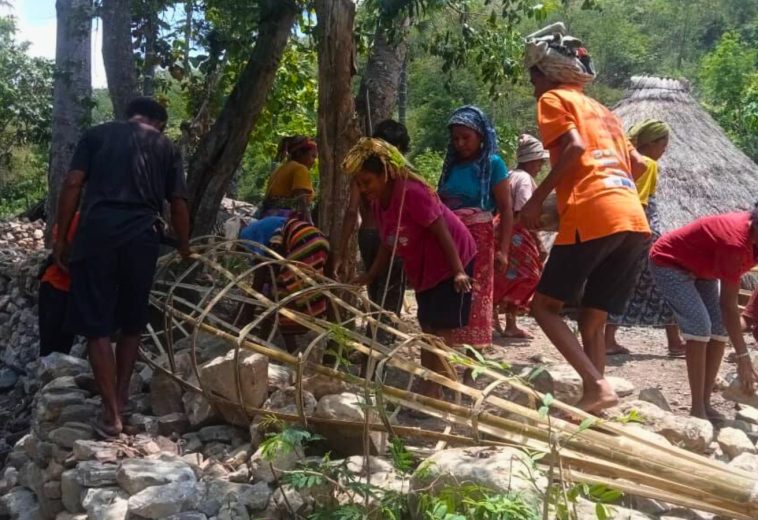
Across communities, Oxfam and its partners support practical, locally led DRR activities that address environmental risks, protect livelihoods and strengthen community preparedness. Water conservation is an important part of this work, helping communities protect natural water sources, improve water management and maintain access to water during dry periods. These efforts are complemented by tree planting and reforestation, which can help reduce soil erosion, protect watersheds and support more sustainable water supplies.
Building rainwater retention ponds and infiltration basins is another practical approach to managing water resources and reducing climate-related risks. By capturing rainfall and allowing water to infiltrate into the ground, these structures can contribute to groundwater recharge, reduce surface runoff and improve water availability for households and agriculture. Combined with spring protection and community-led water management, these interventions help strengthen the foundations of resilience, particularly in areas vulnerable to drought and water scarcity.
Oxfam and its partners also support measures such as local gabion construction, flood mitigation and terrace building to help address soil erosion, manage water runoff and protect agricultural land and community infrastructure. Alongside these physical interventions, community disaster preparedness planning and awareness-raising help people identify local hazards, understand risks and strengthen their capacity to prepare for and respond to emergencies.
These activities are not simply infrastructure projects or environmental initiatives. They represent communities taking action to protect their surroundings, safeguard livelihoods and reduce disaster risks before emergencies occur.
For example, in Oe-Cusse, Oxfam and AFFOS have supported community-led water conservation, tree planting, infiltration basins and gabion construction in Suco Cunha. In Ermera, Oxfam and KSI have supported water conservation, tree planting and terrace-building initiatives in Matata.
When communities protect water sources, plant trees, build retention ponds and strengthen local preparedness, they are investing in resilience that can benefit households today and future generations.
Resilience is Built by People Working Together
While resilience starts at home, it cannot be built by households alone. It requires a collective effort – from communities and local leaders to civil society organisations, government institutions and humanitarian teams.
At Oxfam in Timor-Leste, building resilience is a shared responsibility across our programme teams, technical specialists, field staff, operations colleagues, communications team and local partners. Each plays a different role, but our efforts are connected by a common purpose: supporting communities to live with greater safety, dignity and security.
Our field teams work closely with communities, listening to local concerns and identifying practical solutions. Programme teams translate these insights into activities that strengthen preparedness, livelihoods, water security and inclusion. Operations and logistics colleagues help ensure that the resources and coordination needed to deliver these activities are in place.
Meanwhile, our communications team helps bring community experiences and local solutions to a wider audience – ensuring that the voices of people leading resilience efforts are heard, recognised and amplified.
Our partners – MANEO, AFFOS, KSI, BIFANO, MDI and RHTO – are equally important to this collective effort. Their local knowledge, community connections and expertise help ensure that DRR activities are grounded in local realities and that communities are active participants in shaping their own resilience.
This is what teamwork in disaster risk reduction looks like: different skills, roles and organisations working together towards a shared goal. Resilience is strengthened when we collaborate, share knowledge, learn from communities and recognise that every contribution matters.
Inclusion Must Begin at Home
The theme “Resilience Starts at Home” also invites us to reflect on whose homes are safe, whose voices are heard and who has the resources to prepare for disasters.
Women often carry significant responsibilities for household care, food security and water collection. Persons with disabilities may face additional barriers when accessing early warnings, evacuation routes and emergency assistance. Children, older people and households with limited resources can also experience particular challenges before, during and after disasters.
These realities remind us that resilience cannot be measured only by infrastructure built or training sessions delivered. It must also be measured by whether people are included, whether their needs are recognised and whether they have the power and resources to make decisions about their own safety.
For Oxfam in Timor-Leste and our partners, inclusive DRR means working to ensure that women, persons with disabilities and marginalised groups are not left behind in preparedness planning, climate adaptation or recovery efforts.
It means asking whose needs may have been overlooked, whose knowledge has not yet been heard, and what more can be done to make resilience accessible to everyone.
A resilient community is not one where some households are safe while others remain exposed. It is one where everyone has the opportunity to participate in building a safer future.
As we mark the International Day for Disaster Risk Reduction on 13 October 2026, “Resilience Starts at Home” is more than a campaign message. It is a reminder of the responsibility we share – as individuals, as teams, as partners and as an organisation – to make disaster risk reduction part of the way we work and live.
Resilience starts at home, but it grows through teamwork, strong partnerships and collective action.
International Day for Disaster Risk Reduction (IDDRR) 2026 | 13 October 2026
Author: Cris Caetano, Oxfam in Timor-Leste